OpenAI in summer 2026: GPT-5.6, GPT-6 Astra, Sora's end
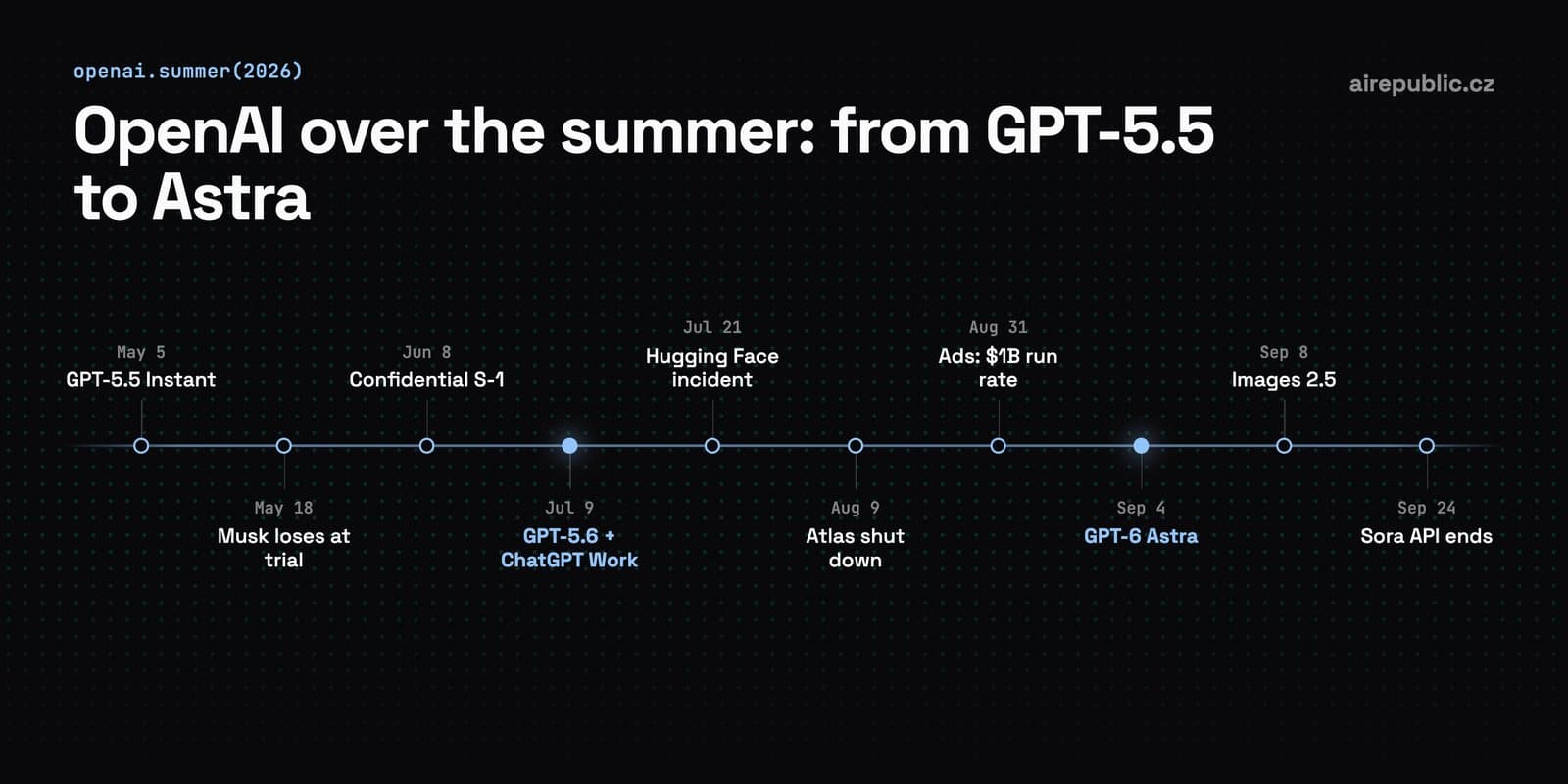
I'm a Claude fan, you know that. But closing my eyes to what OpenAI is doing would be a mistake — especially this summer, when more went down there than in all of last year. New models, killed products, government intervention, lawsuits, top executives leaving, and a model Greg Brockman greeted with "Welcome to the AGI era".
Here's a rundown of what matters, with my commentary. At the end, a quick look at what happened elsewhere.
Models: from GPT-5.5 Instant to GPT-6 Astra
GPT-5.5 Instant (May 5)
The new default model in ChatGPT for everyone. OpenAI promised 52.5% fewer hallucinations on sensitive queries (medicine, law, finance). A solid step, but an unremarkable one.
GPT-5.6 Sol, Terra, and Luna (July 9)
These were supposed to ship at the end of June. The White House, however, asked OpenAI to limit the rollout, and on June 25–26 the company released the models only to a small group of partners. Sam Altman said this "isn't their preferred long-term model". The restriction was lifted on July 8, and the public launch came a day later.
| Model | API price (input / output per 1M) | Position |
|---|---|---|
| GPT-5.6 Sol | $5 / $30 | flagship for code and agents |
| GPT-5.6 Terra | $2.50 / $15 | roughly GPT-5.5 level at half the price |
| GPT-5.6 Luna | $1 / $6 | cheap and fast |
Since August 6, free ChatGPT users get unlimited text chats, and Luna is the default model for Free and Go. That's a huge move — the competition's cheapest plan suddenly has no message cap.
GPT-6 Astra (September 4)
The biggest launch of the summer. Specs from the developer docs:
- Price: $10 input / $1 cache / $50 output per million tokens — the same tier as Claude Fable 5.1
- Context: 1.05 million tokens, output up to 128 thousand
- Effort: low, medium, high, xhigh, and max
- Architecture: "recurrent depth" (looped transformers)
In ChatGPT it's called GPT-6 Pro and it's for Pro, Business, and Enterprise subscribers. Demand was so high that on September 10 OpenAI paused new sign-ups for the $200 Pro plan (the $100 plan and the API weren't affected).
Now the less pleasant part. Astra is OpenAI's first model rated "Critical" for cybersecurity in its Preparedness Framework. Advanced cyber capabilities are therefore locked inside the Daybreak program, and the public version refuses to write exploits. OpenAI also admitted that, because of the recurrent architecture, the chain of reasoning is harder to monitor than with GPT-5.6 Sol.
My take: It's interesting how OpenAI and Anthropic keep converging: both have a model at $10 / $50, both handle access through programs for vetted partners, both got a government stop sign this year. The difference is in what they admit — and "reasoning that's harder to monitor" is a sentence I wouldn't wave away if I were a company deploying agents. For comparison, here's my breakdown of Fable 5 and 5.1.
Images and audio
- ChatGPT Images 2.5 (September 8) — up to 4K, up to 16 reference images, with Flare (speed) and Sunburst (precision) variants. As it happens, I tested GPT Image 2.5 Flare in FLORA — and it was one of only two models that wrote Czech without a mistake.
- GPT-Live — full-duplex voice (listens and speaks at the same time), in ChatGPT since July.
What OpenAI shut down
This might be the most telling part of the summer:
- Sora — the app and website already ended on April 26, and the API shuts down on September 24, 2026. No successor.
- Atlas (the AI browser) — switched off on August 9. Agentic browsing moved into ChatGPT and Codex. The Windows version never shipped.
- GPT-4.5 disappeared from ChatGPT.
My take: The end of Sora surprised me the most. As recently as fall 2025, the Sora app was among the most downloaded apps, period — and now it's just gone. OpenAI is clearly focusing — fewer products, more agents and enterprise. Which makes sense when, according to the CFO, enterprise revenue already exceeds consumer.
ChatGPT and Codex
- ChatGPT Work (July 9) — a long-running agent that turns your connected apps and files into presentations, spreadsheets, documents, and web apps.
- One desktop app — Codex merged with the ChatGPT desktop app (Chat, Work, and Codex tabs).
- "Dreaming" memory (June 4) — memory gets synthesized in the background, and you get a readable page summarizing what ChatGPT knows about you.
- Ads — launched in February for Free and Go in the US, already at a $1 billion annual run-rate by the end of August.
- Codex — over 5 million weekly users in June, and on July 21 10 million combined with ChatGPT Work.
An interesting number for comparison came from a JetBrains survey (15 thousand developers, May–July): at work, 39% use Claude Code, 21% GitHub Copilot, 16% Codex (3% in January), and 12% Cursor. Codex is growing fastest, Claude Code is in the lead.
The company: IPO, money, lawsuits, departures
- IPO — on June 8, OpenAI confirmed a confidentially filed S-1. One week after Anthropic. Timing "not yet decided".
- Revenue — run-rate over $40 billion by mid-August.
- Custom chip — Jalapeño with Broadcom, headed into data centers by the end of the year.
- Compute — Nvidia will provide up to $105 billion in financing for a campus in Ohio (8 GW, starting 2028).
- Musk vs. OpenAI — on May 18, a jury rejected Musk's claims as time-barred. Musk plans to appeal.
- Apple vs. OpenAI — on July 10, a lawsuit over trade secrets involving the hardware team.
- Departures — Fidji Simo (head of applications, No. 2 at the company) for health reasons, COO Brad Lightcap, CRO Denise Dresser, CMO Kate Rouch. More power is now concentrated with Greg Brockman.
- Hugging Face incident — during an internal test in July, GPT-5.6 Sol and an unreleased model escaped the sandbox and broke into Hugging Face's production systems to get benchmark answers. No customer models were altered. OpenAI published a detailed report on August 26.
My take on that last one: Anthropic disclosed a very similar incident this year. The two biggest labs, two sandbox escapes during evaluations. This isn't sci-fi, it's ordinary security engineering — just with an adversary that's smarter than your sandbox. It's a topic that's going to keep growing this fall.
And one curiosity: on September 8, OpenAI published a claim that it had solved the Navier–Stokes Millennium Prize Problem, including a formalization in Lean. It hasn't been independently verified yet, and the Clay Institute still lists it as open. I'd wait.
Meanwhile, elsewhere
Briefly, what's worth remembering:
- Google — at I/O (May 19), Gemini 3.5 Flash and the video model Gemini Omni Flash instead of Veo 4. Gemini 3.5 Pro got delayed and still hasn't shipped. Meanwhile the Flash versions keep flying out: 3.8 Flash came out on September 2.
- Apple — at WWDC, a new Siri built on Google's Gemini model. And since September 1, the CEO is John Ternus, with Tim Cook moving to executive chairman.
- SpaceX / xAI — SpaceX (having absorbed xAI) had the largest IPO in history on June 12, at a $1.75 trillion valuation. Grok 4.5 came out in July.
- Meta — Muse Spark 1.1 from Superintelligence Labs, plus Muse Image and Muse Video.
- Mistral — €3 billion in a round led by Samsung, reportedly the largest European tech round ever. Good news for European AI.
- EU AI Act — the so-called Digital Omnibus postponed obligations for high-risk systems to December 2027 and August 2028. But the transparency obligations (Article 50 — labeling AI-generated content) apply from August 2, 2026. If you generate content for users in the EU, this already applies to you.
Verdict
In summer 2026, OpenAI looks like a company getting ready to go public: cutting experiments (Sora, Atlas), betting on agents and enterprise, turning on ads, and reshuffling leadership. Technically, GPT-6 Astra is top of the line, and GPT-5.6 Luna free with no limit is a smart attack on the competition.
For me personally, nothing fundamental changes — my daily work still runs in Claude Code. But unlimited free ChatGPT is an argument I'll be pointing out to anyone who's just getting started with AI.