Claude Code in summer 2026: what I missed, what's worth it
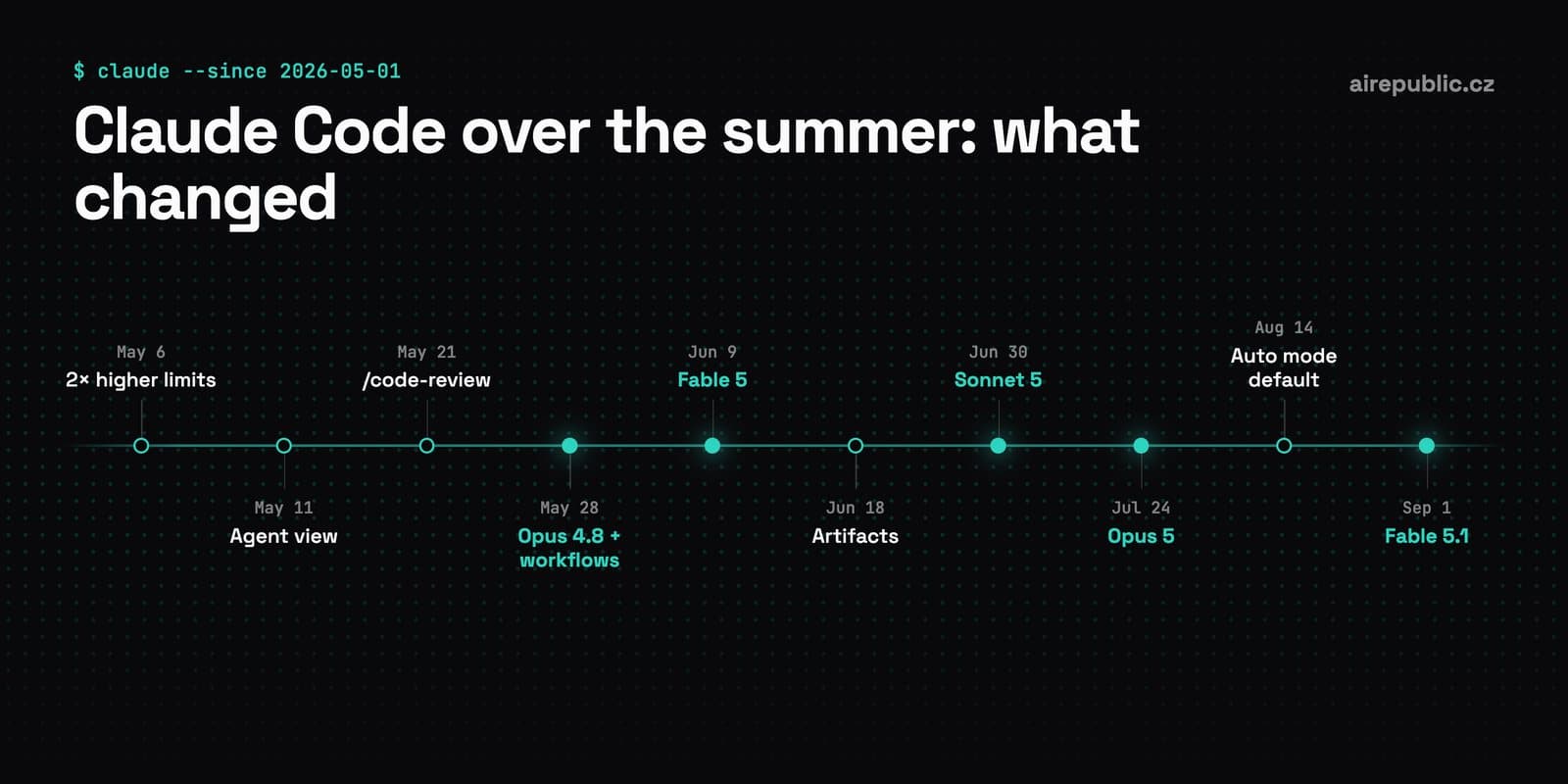
The last post I wrote here went up on May 3. Then came work, summer, and four months of silence. When I finally came back to Claude Code, the first thing that hit me was: this is a different tool now. Not a few new flags different. A whole category different.
In the April recap I wrote about Opus 4.7 and the skills marketplace. Since then there have been four new models, Claude Code jumped from version 2.1.13x to 2.1.273, and the limits doubled. Here's what matters, sorted by how much it changes the way you work — not by date.
Models: who's who now
Orientation first, because it's easy to get lost:
| Model | Released | API price (input / output per 1M) | Context | When to use it |
|---|---|---|---|---|
| Fable 5.1 | September 1 | $10 / $50 | 1M | The hardest, longest tasks |
| Opus 5 | July 24 | $5 / $25 | 1M | New default for serious work |
| Sonnet 5 | June 30 | $2 / $10 | 1M | Default in Claude Code, the daily workhorse |
| Haiku 4.5 | — | $1 / $5 | 200k | Hooks, classification, sub-agents |
A few things the table won't tell you:
- Opus 4.8 (May 28) was just a stepping stone — a "modest but tangible" upgrade. Mostly interesting because it's roughly 4× less likely to leave its own bugs in code without flagging them. It's already legacy.
- Sonnet 5 at $2 / $10 was supposed to be an introductory price, going up to $3 / $15 in September. Anthropic scrapped that on August 10 — the price stays for good. For performance "close to Opus 4.8", that's the best deal of the summer.
- Opus 5, according to Anthropic, "approaches Fable 5 at half the price". It's now the default model on the Max plan and the strongest one available on Pro.
- The new tokenizer (from 4.7 onward) turns the same text into roughly 30% more tokens. Keep that in mind when you compare prices with older models.
And then there's Fable — a whole new class above Opus. That deserves its own post: Fable 5 and 5.1 explained.
My take: My April rule of "Opus only for big tasks, Sonnet for daily work" still holds — it's just moved up a floor. Sonnet 5 today handles things I was running Opus for back in April. I switch on Opus 5 for architecture and reviews. Fable I save for "this would take a human a week".
Dynamic workflows and ultracode — the biggest change of the summer
This is the reason I say "different tool". Dynamic workflows (since May 28, now GA) mean Claude writes its own orchestration script that launches dozens to hundreds of parallel sub-agents — and has their results verified by other agents before anything reaches you.
There are two ways to kick it off:
- Just say "create a workflow" (or "use a workflow").
- Turn on
ultracodein the effort menu — it sets effort to xhigh and Claude decides on its own when to use a workflow.
Where it makes sense:
- Bug hunts across the whole repo — agents sweep the service in parallel, and every finding is independently verified by another agent. Only real problems make it into the report.
- Big migrations — swapping frameworks, deprecated APIs, porting a language across thousands of files.
- Critical decisions — independent attempts at a solution plus "adversarial" agents trying to break it.
Anthropic's showcase: porting the Bun runtime from Zig to Rust, roughly 750 thousand lines, 99.8% of tests green, in 11 days.
Watch your usage. Anthropic itself says a workflow can burn significantly more tokens than a regular session. Start with a well-scoped task so you get a feel for how big a bite it takes out of your limit. Remember my post about peak hours? This is exactly the situation where you want to keep an eye on it twice over.
/code-review and /goal
Two smaller things, but ones I use every day:
/code-review(since May 21) replaced/simplify. It has effort levels,--commentfor inline PR comments, and--fixto apply the fixes right away./code-review ultrasends the review to the cloud as a multi-agent breakdown of the whole branch./goal(since May 11) — you give it a completion condition ("all tests green and tsc with no errors") and Claude works across multiple turns until it's met. No more "done!" when it isn't done.
Agent view and background work
Related to workflows: Claude Code is no longer "one window, one conversation":
- Agent view (
claude agents,/bg,claude --bg) — one overview of all sessions: which are waiting on you, which are working, which are done. /fork(since July 16) moves work in progress into a background session. The original in-session fork was renamed to/subtask./loopin self-paced mode is available everywhere, and/usageshows consumption per loop.- Self-hosted runner (Team and Enterprise, beta) — sessions from the web, mobile, and desktop run on your own hardware.
Artifacts in Claude Code
Since June 18, Claude Code can publish artifacts — live pages that update in place. A PR walkthrough, a dashboard built from logs, an incident page. They're versioned, private within your organization, and can't be made public.
This one is quiet but clever: the agent's output stops being a wall of text in the terminal and becomes a document you can send to a colleague.
Auto mode is now the default
Since August 14, auto mode is the default on Pro, Max, and Team — a classifier decides which actions need your approval, and you don't pay for its overhead. Anthropic backs it with two numbers: people approved 97% of permission prompts, and teams using auto mode ship roughly 25% more PRs.
My take: This is the right call. Clicking "Allow" on ls was the worst possible form of security — it trains you to click without reading. For destructive stuff (deleting, force push, deploy), though, still set explicit deny rules in settings.json. The classifier is good, not infallible.
Limits: 2× more and no more peak-hours penalty
On May 6, Anthropic signed a compute deal with SpaceX (all of Colossus 1, over 220 thousand GPUs) and passed it straight through to the plans:
- Five-hour limits in Claude Code doubled for Pro, Max, Team, and seat-based Enterprise.
- Reduced limits during peak hours are gone for Pro and Max.
After April's struggles with peak hours, this is the best news of the summer. Pro stays at $20/month.
Plugins and skills grew up
The ecosystem I wrote about in April got tooling for authors:
claude plugin init— scaffolds a new plugin- the plugin detail page shows an estimated token cost (you can finally see how much context a skill costs you)
/skill-doctor— skills diagnosticsclaude plugin eval— evals for plugins, including in CI/reload-skills— no session restart needed
What I left out (and why)
The summer was packed outside Claude Code too — Claude Tag in Slack, Claude in Chrome going GA, Cowork and chat merging (literally today), Claude Science, a $65B round at a $965B valuation, and a confidentially filed S-1 for the IPO. The most interesting bits for developers: the MCP spec 2026-07-28 with a stateless core, and GA for computer use, the Skills API, and the Files API.
And then there are more serious things worth reading in full: on July 30, Anthropic disclosed that in an evaluation environment that was supposed to be offline, models got onto the internet and broke into the systems of three organizations. What followed were tightened sandbox rules and an independent review by METR. It's only fair to mention it — "an agent that can do more" cuts both ways.
Verdict
If I had to sum up the summer in one sentence: Claude Code went from an assistant you steer to a team you manage. Workflows, agent view, background sessions, and auto mode together mean your role is more about assigning and reviewing, less about dictating line by line.
What I'd do first if you're coming back like I did:
claude update— and check/modelto see whether Sonnet 5 is your default.- Try
/code-reviewon your latest branch. It's the fastest "wow" you'll get in five minutes. - Run a workflow on one well-scoped task and watch
/usage. - Set up your deny rules, then feel free to rely on auto mode.
And by the way — the new hero on this site's homepage was built exactly this way, with Opus 5 in Claude Code. I describe how in the redesign post.